
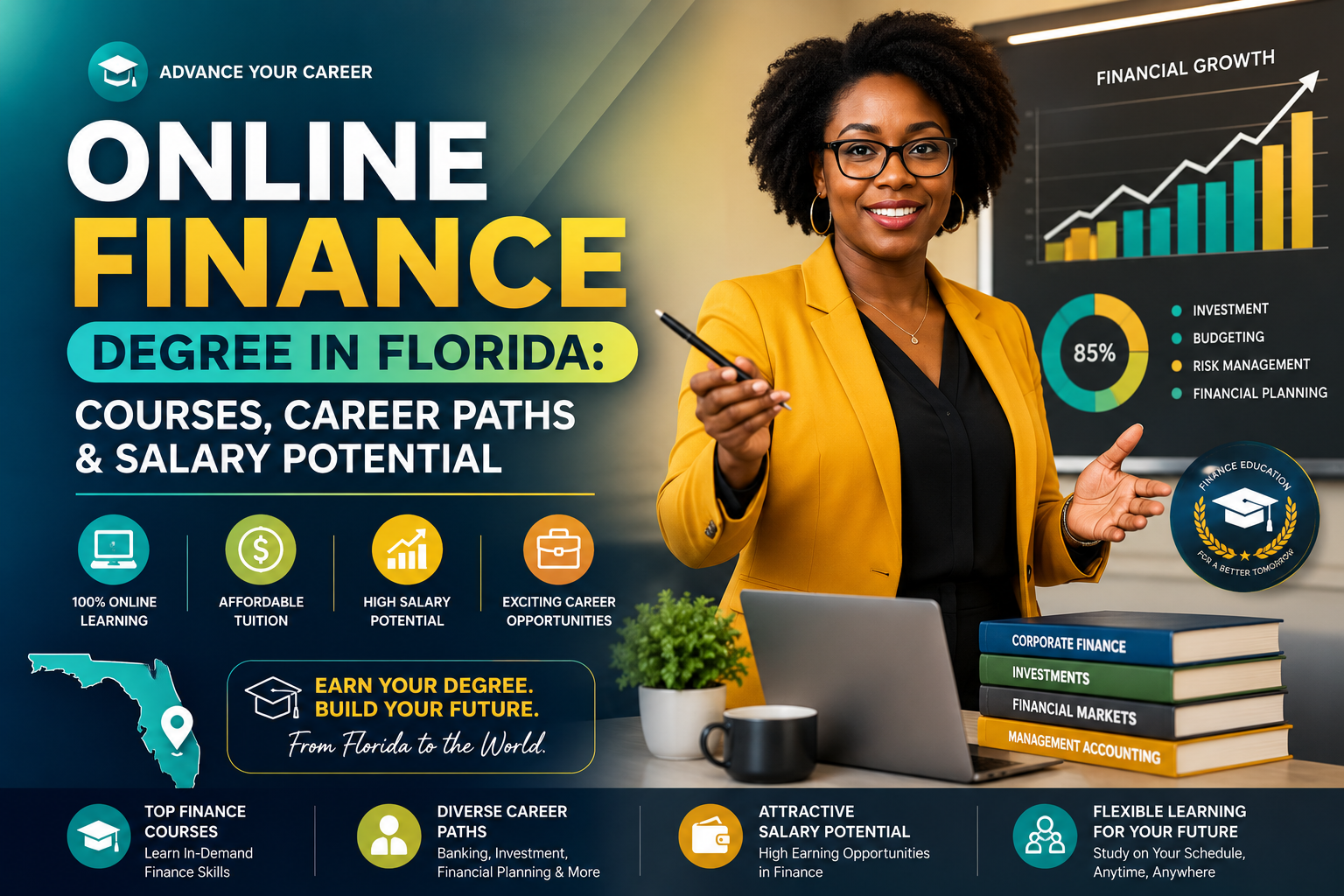
My neighbor Carily spent almost a year going back and forth on whether to quit her job and go back to school full-time for finance, or just… not bother. She was 34, working as a bookkeeper for a small property management company in Tampa, and she kept telling me the same thing every few months: “I know I need the degree to move up, but I can’t afford to stop working.”
I ended up helping her research online finance programs in Florida over a few weekends (mostly because I’d gone through something similar myself a few years earlier when I switched from an accounting associate’s degree into a finance bachelor’s). What surprised both of us was how much the online options had matured. This wasn’t the sketchy “diploma mill” stuff people used to warn you about in 2015. We’re talking about the same professors, the same course catalog, and in some cases a cheaper price tag than sitting in the classroom.
If you’re in the same spot Priya was — working, maybe raising kids, trying to figure out if an online finance degree from a Florida school is actually worth the time and money — this is everything I learned going through the process with her, plus a few things I wish someone had told me before I signed up for my own program.
Why Florida specifically?
Florida has a weird advantage that a lot of people don’t think about: in-state online tuition. Florida runs one of the more generous state university systems for distance learners, and schools like the University of Florida, Florida State University, the University of South Florida, Florida International University, and the University of West Florida all have fully online business or finance tracks that Florida residents can access at a serious discount compared to out-of-state or private-school pricing.
There’s also just a lot of finance work in the state. Miami has a real banking and wealth management scene (a lot of Latin American finance business runs through Miami), Tampa and Jacksonville have big insurance and financial services employers, and Orlando has a surprising amount of corporate finance work tied to hospitality and entertainment companies. So it’s not like you’re getting a degree with no local job market to use it in.
What the coursework actually looks like
Priya assumed an online finance degree would just be “watch some videos, take a quiz.” It’s not that. Here’s roughly what a bachelor’s in finance covers at most of these Florida programs, based on what she enrolled in and what I remember from mine:
- Principles of Financial Accounting and Managerial Accounting — the foundation courses. If you’ve never touched a balance sheet, this is where you learn.
- Corporate Finance — how companies decide what to invest in, how they raise money, capital budgeting, all that.
- Investments — stocks, bonds, portfolio theory, risk and return. This is the class most people actually enjoy.
- Financial Markets and Institutions — how banks, the Fed, and capital markets connect to each other.
- Statistics and Business Analytics — heavier on math than people expect, usually taught with Excel and sometimes a stats tool.
- Financial Modeling / Valuation — building spreadsheets to value companies, often the class that feels most “real world.”
- Business Law and Ethics — required almost everywhere, kind of dry but necessary.
- Capstone or Applied Finance Project — usually a case study or simulation near the end.
A lot of the newer programs have also folded in fintech-adjacent electives — things touching on data analytics, Python or R basics, and even some blockchain/crypto overview courses. Not because you need to become a programmer, but because employers increasingly expect finance grads to be comfortable pulling and manipulating data instead of just building formulas by hand.
The tools you’ll actually use
This part matters more than the syllabus. Real talk about what’s on your screen most of the week:
- Excel — you will live in Excel. If you’re rusty, spend a weekend on a free course (YouTube’s “Excel is Fun” channel got Priya through the modeling class) before your first finance course.
- Canvas or Blackboard — whatever learning management system your school uses. UF and FSU both run on Canvas, which is honestly pretty painless once you get used to it.
- Proctorio or Honorlock — remote exam proctoring software. This one trips people up. It uses your webcam and can flag you for looking away too much or having someone walk into the room. Test your internet and lighting before exam day, seriously.
- Bloomberg Terminal or Yahoo Finance/Wall Street Journal data — some investments courses give you limited access to a Bloomberg terminal simulation or just have you pull real data from free sources for assignments.
Step-by-step: how we actually picked a program
Here’s the process Priya and I used, roughly in order, in case you want to copy it:
- Check residency first. Florida in-state tuition rates for online programs are dramatically lower than out-of-state or private-school pricing. If you’ve lived in Florida for 12+ months, confirm your residency status with the school’s registrar before you apply, because this affects your cost more than almost anything else.
- Look at accreditation, specifically AACSB. This is the business school accreditation that actually matters to employers and to grad schools if you ever want an MBA later. UF, FSU, USF, and FIU business programs all carry it. If a school you’re considering doesn’t have AACSB accreditation for its business college, ask why.
- Compare total credit hours and per-credit cost, not the sticker “tuition.” Schools advertise different numbers (per credit hour, per semester, total program cost) and it gets confusing fast. Ask admissions for a flat total-cost estimate for your specific situation, in writing.
- Ask about the “same degree, same faculty” question directly. Some online programs are taught by adjuncts who never touch the campus program. Others (like UF Online) use the exact same instructors and course numbers as the on-campus version, which matters if you care about how the degree looks on paper.
- Look up the transfer credit policy if you’re coming from a community college. Florida’s statewide articulation agreement means an AA from a Florida College System school (like Hillsborough Community College or Miami Dade College) should transfer cleanly into most state university finance programs. Double-check this with an advisor before you assume it.
- Ask about internship or practicum support, even for online students. This was the one thing Priya almost skipped checking, and it ended up being the deciding factor for her. USF’s online program had a career services team that actively matched remote students with local internships. Not every school does this well.
What it actually costs
I’m going to give you real numbers instead of vague ranges, because that’s what actually helps.
At the University of Florida, UF Online undergraduate tuition runs a flat per-credit rate for Florida residents that comes out to roughly $3,800–$4,000 a year in tuition and fees for a full course load, which is noticeably less than the on-campus rate. Out-of-state students pay significantly more — closer to $16,000+ a year — because Florida’s discounted online rate is really built around in-state residents.
Other state schools land in a similar ballpark for residents, usually somewhere between $6,000 and $9,000 a year total when you add books and fees, though this varies by program and whether you’re doing undergrad or a master’s. Master’s programs run higher per credit hour than bachelor’s programs, generally.
The honest advice here: don’t trust any number you see on a random “best online finance degree” listicle site. Go straight to the specific program’s tuition and fees page (every one of these schools publishes it) and run the math for your residency status and expected credit load. It changes year to year.
Career paths that actually open up
Here’s where I think a lot of articles oversell things, so let me be straight about what a finance bachelor’s realistically leads to.
Financial analyst — probably the most common first job. You’re building models, analyzing budgets, doing variance reports. Entry-level in Florida tends to land somewhere in the low-to-mid $40,000s to $50,000s depending on the city and company, with experienced analysts climbing well past that, especially in Miami and Tampa where there’s more competition for good analysts.
Personal financial advisor — this path usually needs licensing (Series 65, or Series 7 and 66 if you’re at a brokerage) on top of the degree, but it’s a common route, especially since Florida has a huge retiree population that needs wealth management help.
Loan officer / credit analyst — banks and credit unions hire heavily for this, and it’s a pretty accessible entry point straight out of an online program.
Budget analyst — a lot of government and healthcare organizations in Florida hire budget analysts, and this tends to be more stable, slightly lower stress than corporate finance roles.
Insurance and risk roles — given how much of the insurance industry is headquartered or heavily present in Florida (thanks, hurricanes), risk analysis and underwriting-adjacent finance roles are genuinely plentiful here.
Corporate finance / FP&A — financial planning and analysis roles inside companies, usually the track people aim for if they want to eventually become a CFO or controller.
If you go on to get a CFA charter or an MBA later, the ceiling goes up considerably, but that’s a separate, longer conversation than the bachelor’s degree itself.
Mistakes people make (including me)
Underestimating the math. I went in thinking finance was mostly “reading about the stock market.” It’s not. There’s real statistics, some calculus-adjacent material in corporate finance, and a lot of formula-heavy work. If math was never your strong suit, take a refresher before your first semester.
Not checking if the online program syncs with your work schedule. Some “online” courses are actually synchronous, meaning you have to log in at a specific time for lectures or group work. Priya almost enrolled in one that required a live 6pm Tuesday session, which conflicted with her job. Always confirm synchronous vs. asynchronous before registering.
Skipping the free tutoring and writing center resources because “it’s online, there’s nothing here.” Every one of these state schools extends their tutoring, writing center, and advising services to online students. Almost nobody uses them, and they’re free.
Assuming the degree alone gets you the job. It doesn’t. The people who did best coming out of these programs were the ones who paired the degree with a part-time internship, a finance-related certification (even something like the Bloomberg Market Concepts free course), or direct networking through their school’s alumni network.
Not asking about advisor turnover. Priya’s first academic advisor left the university two months into her first semester and nobody reassigned her for weeks. She had to be the one to follow up. Online students can slip through the cracks more easily than in-person ones, so be a little more proactive about chasing your advisor down than you might expect to need to be.
How to actually get started this week
If you’re ready to move on this, here’s a realistic first step: pick two or three schools (I’d suggest starting with UF Online, USF’s online finance track, and FIU if you’re in South Florida), request their online program info packets, and book a call with an admissions counselor at each one. Ask them directly for a total cost estimate based on your residency and credit situation, and ask what a typical weekly time commitment looks like for a working adult. That one phone call tends to clear up more confusion than a week of googling.
Priya ended up going with USF’s program. She’s about a year and a half in now, still working full-time, and picked up a part-time internship at a regional bank through the school’s career office last semester. It’s not fast, and there were a few rough semesters where she almost gave up on a stats course. But she’s on track, and the degree is costing her a fraction of what a private out-of-state school would have.
FAQs
Is an online finance degree from a Florida public university respected by employers the same as an in-person one? Generally yes, especially from AACSB-accredited programs like UF, FSU, USF, and FIU. Most diplomas don’t even specify “online” on them, and employers care more about the school name, your GPA, and any internship or experience than the delivery method.
How long does it take to finish an online finance bachelor’s degree in Florida? Full-time students typically finish in about four years. Working adults taking two or three classes a semester often take five to six years. Some schools offer accelerated terms that can shave time off if you’re able to take summer courses too.
Do I need to be a Florida resident to get the discounted online tuition rate? It depends on the school. Programs like UF Online offer their discounted rate specifically to Florida residents, and out-of-state students pay a higher rate. A few programs have flat online rates regardless of residency, so it’s worth checking each school individually.
Can I transfer an associate’s degree from a Florida community college into an online finance bachelor’s program? Usually yes, through Florida’s statewide articulation agreement, especially if your AA is from a Florida College System school. Talk to an advisor early to confirm which specific courses transfer, since electives can vary.
What’s the realistic starting salary for a finance degree holder in Florida? It varies a lot by role and city, but entry-level financial analyst positions in Florida commonly start somewhere in the $40,000s to low $50,000s, with room to grow into the $70,000s and beyond within five to ten years, especially with added certifications or a master’s degree.