
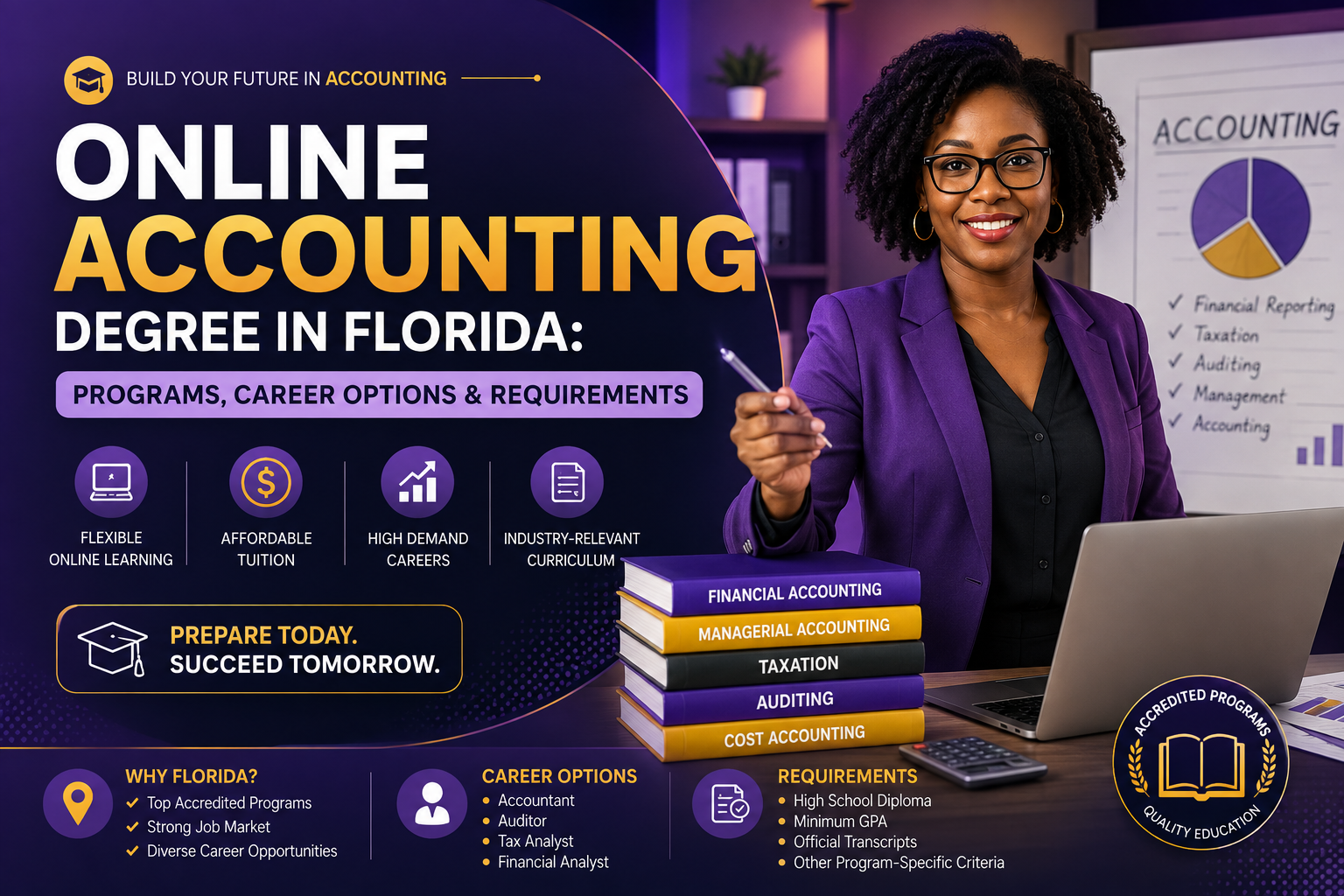
I still remember sitting in a Tampa coffee shop with my laptop open to three different university websites, a cold cup of coffee next to me, and absolutely no idea which one to trust. I was 27, working a front-desk job at a dental office, doing their books on the side because I was “good with numbers,” and I kept getting told the same thing by everyone who actually worked in finance: “You need a degree if you want to move up.” So I started looking into online accounting programs in Florida, and honestly, the whole process was messier than I expected.
That was almost five years ago. I finished my degree, passed part of the CPA exam (still working on the rest, no shame in admitting that), and now I do remote bookkeeping and tax prep for small businesses. Along the way, I made some dumb decisions — picked a program without checking accreditation properly, wasted money on a laptop that couldn’t handle accounting software, and almost signed up for a school that wasn’t even licensed to operate in Florida. So if you’re where I was, staring at a screen trying to figure out which program actually makes sense, I want to walk you through what I wish someone had told me.
Why Florida Specifically Matters Here
People assume an online degree is an online degree no matter where you live, but that’s not quite true when it comes to accounting. Florida has its own CPA licensing rules through the Florida Department of Business and Professional Regulation (DBPR), and those rules affect what kind of program you should pick, even if the school itself is based somewhere else entirely.
Florida requires 150 semester hours of college credit to sit for the CPA exam and get licensed — not the standard 120 hours you’d need for a regular bachelor’s degree. That tripped me up early on. I originally enrolled thinking a four-year bachelor’s would be enough, then found out halfway through that I’d need another 30 credit hours somewhere, either through a master’s program or extra coursework, if I ever wanted to be a licensed CPA in this state.
If you’re not planning to become a CPA and just want to work in accounting, bookkeeping, or as a controller somewhere, this doesn’t matter as much. But if CPA licensure is even a maybe for you down the road, plan for those 150 hours from day one. It saves a ton of headache later.
The Programs That Are Actually Worth Looking At
I looked at close to fifteen schools before narrowing things down. Here’s what I found useful to know about the realistic options in Florida.
University of Florida (UF) – Online UF’s Fisher School of Accounting has a solid reputation, and their online offerings (through UF Online) are accredited by AACSB, which is the gold standard for business schools — only about 5% of accounting programs worldwide have it. Tuition is reasonable for Florida residents, and a lot of employers in the state recognize the name immediately. Their online master’s in accounting is a popular route for people trying to hit that 150-hour requirement.
Florida International University (FIU) FIU has both an online bachelor’s completion program and a Master of Accounting. It’s AACSB accredited too, and FIU has a strong presence with employers in South Florida especially — Miami, Fort Lauderdale, that whole corridor. If you already have some college credits and want to finish your degree online, this is one of the more flexible options.
University of Central Florida (UCF) UCF’s online accounting programs are known for being budget-friendly while still holding solid accreditation. A lot of people I met in accounting forums went this route because UCF has huge enrollment numbers and a well-established online infrastructure — they’ve been doing distance learning longer than most schools.
Florida Atlantic University (FAU) FAU offers an online Master of Accounting that’s designed for working adults, with classes often scheduled asynchronously so you’re not stuck logging in at a specific time every week. This mattered a lot to me since I was working full time.
Saint Leo University This one’s a private Catholic university based in Florida with a long-running online program. It’s regionally accredited (SACSCOC) but not AACSB accredited, which matters if you’re picky about prestige, but honestly for a lot of bookkeeping and general accounting jobs, employers care more about the degree itself and your experience than the specific accreditation body.
Southern New Hampshire University (SNHU) and Western Governors University (WGU) These aren’t Florida schools, but they’re licensed to operate in Florida and a huge number of Florida residents go through them because of lower cost and flexible pacing. WGU in particular uses a competency-based model, meaning you move through material at your own speed instead of following a semester schedule. I have a friend who finished her WGU accounting degree in under two years by pushing through coursework faster than a traditional pace.
A Mistake I Made (So You Don’t Have To)
I almost enrolled in a program that sounded great on paper — flashy website, aggressive marketing emails, “enroll today” pop-ups everywhere. Took me longer than it should have to notice it wasn’t accredited by any recognized agency, just some vague “nationally recognized” label that meant basically nothing. When I mentioned the school’s name to an accountant at a firm I was interviewing with, she just shook her head.
Here’s the lesson: before you pay a dime, check the school on the U.S. Department of Education’s database (ope.ed.gov) and confirm it’s either regionally accredited (SACSCOC for Florida schools) or has AACSB accreditation for the business program specifically. Regional accreditation is the baseline you need — without it, credits often don’t transfer, and some employers and licensing boards won’t even count the degree.
Step-by-Step: How to Actually Choose a Program
1. Decide if you want to be a CPA. This changes everything. If yes, look for programs that either offer 150 credit hours built in (often through a combined bachelor’s/master’s track) or have a master’s program you can add on afterward.
2. Check accreditation first, price second. I know tuition matters — it mattered a lot to me too — but a cheap degree from an unaccredited school is money down the drain. Confirm SACSCOC or regional accreditation minimum, AACSB if you can swing it.
3. Look at the delivery format. Some programs are fully asynchronous (do the work whenever), some have set login times for lectures, and some are hybrid with occasional in-person requirements. FAU and UCF lean asynchronous-friendly. Ask directly before enrolling — I called admissions offices and just asked, “Do I need to log in at a specific time each week?”
4. Ask about internship or practicum connections. UF and FIU both have decent career services that connect students with local firms for internships, even in online programs. This matters more than people think — my first real job came through a professor who forwarded my resume to a small firm in Orlando.
5. Check total cost including fees. Florida residents get in-state tuition rates at public schools like UF, UCF, FAU, and FIU, which is a massive difference — sometimes half the cost compared to out-of-state or private online options. If you’ve lived in Florida for at least 12 months, confirm your residency status before applying.
6. Read the fine print on transfer credits. If you already have some college credit (I had about 45 credits from years earlier), ask exactly which ones transfer before you commit. I lost about 9 credits in my transfer because of course mismatches, and that cost me an extra semester.
What The Actual Coursework Looks Like
People picture accounting school as just spreadsheets and calculators, but there’s more variety than that. My coursework included:
- Financial accounting and managerial accounting (the foundational stuff)
- Auditing principles
- Federal taxation (individual and business)
- Cost accounting
- Accounting information systems — this is where you learn software like QuickBooks, SAP, and sometimes Excel modeling at a level way beyond basic spreadsheets
- Business law
- Ethics in accounting (yes, this is a required course pretty much everywhere, and it’s more interesting than it sounds once you get into real fraud case studies)
Software-wise, expect to get comfortable with QuickBooks Online, Excel (deep, not just SUM formulas), and depending on the program, tools like SAP or Oracle NetSuite for the systems classes. If you’ve never touched QuickBooks before, I’d honestly recommend playing around with the free trial before your first semester just so the learning curve isn’t as steep.
Career Options After Graduation
This is the part people usually skip past, but it’s the whole point, right? Here’s where an accounting degree in Florida can actually take you.
Staff Accountant / General Accountant Entry-level roles at firms or companies handling reconciliations, journal entries, basic reporting. Starting pay in Florida tends to run somewhere in the $48,000–$58,000 range depending on the city — Miami and Orlando tend to pay a bit more than smaller markets.
Bookkeeper Doesn’t always require a full degree, but having one makes you more competitive, especially for remote bookkeeping work, which is what I ended up doing. Small business owners want someone who actually understands the “why” behind the numbers, not just data entry.
Tax Preparer Seasonal or year-round work, especially valuable during tax season (January through April is brutal hours but decent pay). Firms like H&R Block hire seasonally, but plenty of small local firms hire year-round preparers too.
Auditor Internal auditors work for companies checking their own processes; external auditors work for firms like the Big Four (Deloitte, PwC, EY, KPMG) or regional firms, checking other companies’ books. Florida has offices for all the Big Four in Miami, Tampa, and Orlando.
Forensic Accountant This one surprised me — investigating financial fraud, working sometimes with law enforcement or in litigation support. Requires more specialized training but it’s a growing niche, especially with insurance fraud cases (and Florida, unfortunately, has plenty of those).
Controller / CFO (long-term path) These are the leadership roles you grow into after years of experience, usually requiring a CPA license along the way. Not an entry point, but worth knowing the ceiling is high if you stick with it.
Government Accountant Florida’s state and local government agencies hire accountants too, and these jobs often come with solid benefits and more predictable hours compared to public accounting firms.
The CPA Exam Question
I get asked this constantly, so let me just address it directly. Having a degree does not automatically make you a CPA. You need to:
- Complete 150 semester hours of education (as mentioned above)
- Pass all four sections of the Uniform CPA Exam (AUD, BEC/now restructured under the new CPA Evolution model, FAR, REG)
- Get the required work experience — Florida requires one year of experience verified by a licensed CPA
- Apply for licensure through the Florida DBPR
The exam itself is genuinely tough. I passed FAR on my second attempt after failing the first time by four points — four points, which still bugs me. Each section costs around $250-$350 to sit for, and if you fail, you pay again. Budget for this. A lot of people underestimate exam costs when planning their degree budget.
Common Mistakes People Make (Beyond What I Already Mentioned)
Not checking state-specific CPA requirements before enrolling. Every state is a little different. If you might move out of Florida later, check whether your credit hours and coursework will transfer for licensure elsewhere too.
Assuming online means easier. It doesn’t. If anything, online accounting coursework demands more self-discipline because nobody’s chasing you down about deadlines. I fell behind twice during my program because I assumed I could “catch up later.” Later came fast.
Ignoring financial aid and FAFSA deadlines. Florida has state-specific aid too, like Bright Futures for eligible students, plus need-based grants. A lot of online students skip applying because they assume online programs don’t qualify — most do.
Underestimating the tech requirements. You need a computer that can actually run accounting software smoothly, reliable internet, and sometimes specific software licenses (some schools include this in tuition, some don’t). I had to upgrade my old laptop halfway through my second semester because it kept crashing during exams — genuinely stressful.
Not networking just because it’s online. Online doesn’t mean invisible. Join your school’s virtual accounting club, attend any optional webinars, connect with professors over email or during office hours. My internship happened because I actually showed up to a virtual info session that maybe fifteen other students bothered attending.
What I’d Tell Someone Starting Today
If you’re weighing whether this is worth it, here’s my honest take: accounting is one of those fields where the online degree genuinely holds up in the job market, more so than a lot of other online degrees people are skeptical about. Employers care about your skills, your software fluency, and eventually your CPA status — not whether you sat in a physical classroom.
Pick a program with real accreditation, plan for 150 credit hours if CPA licensure is even a possibility for you, and don’t skip the software training even if it feels tedious. The degree gets you in the door. What you do with QuickBooks, Excel, and your first few clients or coworkers is what actually builds the career.
It took me about three and a half years total, working full time while studying part time. Some semesters I wanted to quit, especially during tax law coursework which felt like reading a different language. But the flexibility of doing it online while still earning a paycheck made it possible in a way that a traditional in-person program never would have for me.
FAQs
1. Can I become a CPA in Florida with only an online degree? Yes, completely. The Florida Board of Accountancy doesn’t distinguish between online and in-person degrees, as long as the school holds proper accreditation (regional or AACSB) and you complete the required 150 semester hours plus pass the CPA exam and get your work experience verified.
2. How long does an online accounting degree take in Florida? A bachelor’s typically takes about four years full-time, but many online students take longer since they’re working while studying — closer to five to six years part-time is common. Accelerated programs like WGU’s competency-based model can sometimes be finished faster if you push through material quickly.
3. Is an online accounting degree cheaper than an in-person one in Florida? Usually, yes, especially at public in-state schools like UF, UCF, FAU, and FIU where you avoid commuting costs, housing, and sometimes even some campus fees. Private online schools vary more, so it’s worth comparing actual total cost, not just the advertised tuition rate.
4. Do I need a master’s degree to become a CPA in Florida? Not necessarily a master’s specifically, but you do need 150 total credit hours, which is more than a standard 120-hour bachelor’s degree. Some people get there through a combined bachelor’s/master’s program, others just take extra undergraduate credits or a graduate certificate.
5. What jobs can I get with just a bachelor’s in accounting, without becoming a CPA? Plenty. Staff accountant, bookkeeper, accounts payable/receivable specialist, tax preparer, payroll specialist, and internal auditing roles are all realistic without a CPA license. The CPA mainly opens doors for higher-level public accounting, signing audit reports, and leadership roles like controller or partner at a firm.