
My cousin texted me last month asking if she could “knock out an MBA in like six months” while working full-time and raising two kids. I laughed, then felt bad for laughing, because I remember asking myself the exact same question when I was researching programs a while back. The marketing pages made it sound so simple. Pick a program, log in a few nights a week, done in a year. Reality had other plans.
If you’re trying to figure out how long an online MBA will actually eat up your life, I’ve been down this road, talked to a bunch of people who finished (and a few who didn’t), and I want to give you the honest version instead of the glossy admissions-page version.
The Short Answer (Then We’ll Get Into the Real Stuff)
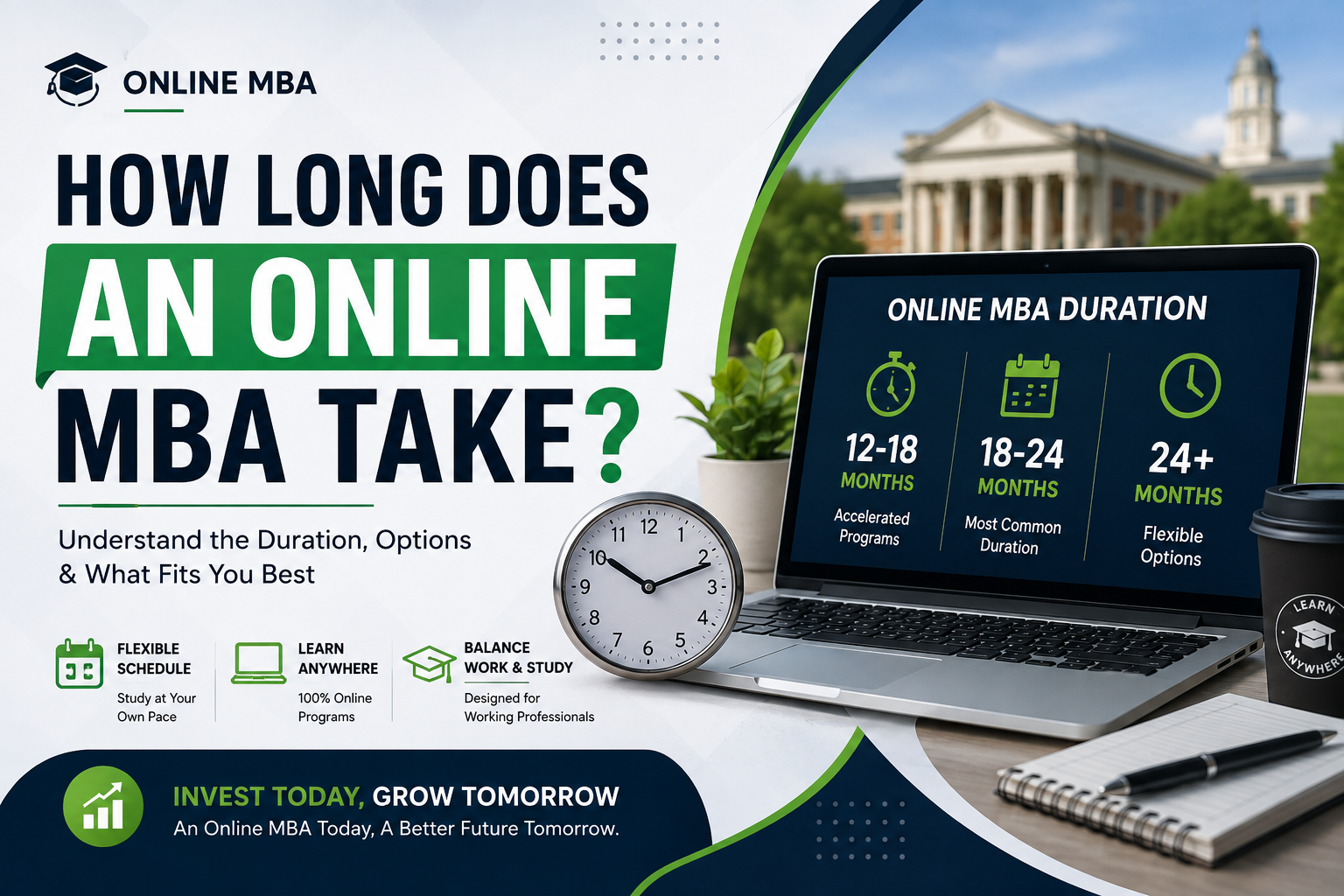
Most online MBA programs take anywhere from 12 months to 3 years, depending on how many courses you take at once, whether you go full-time or part-time, and whether the school runs on a lockstep cohort model or lets you set your own pace.
But that range is basically useless on its own, because the difference between a 12-month program and a 3-year program isn’t just “some people are faster.” It’s about life circumstances, the type of program, and honestly, how realistic you were when you signed up.
Let me break down what actually determines your timeline.
What Actually Decides How Long Your MBA Takes
1. Full-Time vs. Part-Time Online MBA
This is the biggest factor, and people underestimate it constantly.
A full-time online MBA (yes, these exist — some schools run them for career-switchers or people between jobs) usually takes 12 to 18 months. You’re taking two or three courses at a time, every term, back to back, with maybe a short break in summer.
A part-time online MBA, which is what most working professionals do, typically takes 2 to 3 years. You’re taking one or two classes per term while still working your regular job.
I went the part-time route because I wasn’t about to quit my job to study business theory. It took me about 28 months. Not because I was slow, but because I deliberately spaced things out during a year when work got insane (more on that mistake later).
2. Cohort-Based Programs vs. Self-Paced Programs
Some online MBAs move you through the program with a set group of classmates, on a fixed schedule, term after term. Think Indiana Kelley Direct, UNC Kenan-Flagler online MBA, or Carnegie Mellon’s online MBA. These have a defined length because everyone moves together. You generally know your finish date on day one.
Other programs, especially ones built for maximum flexibility (like some offerings through University of Illinois’s Gies College of Business or WGU’s business programs), let you go at your own speed. Finish fast if you can grind through courses, or slow down if life gets in the way.
I actually started in a self-paced program first and switched to a cohort-based one halfway through. Big difference in experience. The self-paced format sounds amazing on paper — total freedom! — but I found I needed the peer pressure of a cohort to actually finish assignments on time. Your mileage may vary, but it’s worth knowing yourself before picking a format.
3. Credit Requirements and Transfer Credits
Most MBA programs require somewhere between 30 and 60 credit hours, depending on the school and whether you need foundational business courses first (accounting, statistics, economics basics) or can skip straight to advanced material.
If you already have an undergrad business degree, some programs let you waive out of foundational courses, which can shave 3-6 months off your timeline. I had a friend with a finance undergrad who tested out of two entire courses just by taking placement exams. That alone saved him a full semester.
Always ask admissions directly: “Which of my previous credits or coursework can reduce my requirements?” Don’t assume — ask explicitly, because a lot of schools don’t advertise this clearly.
4. How Many Courses You Take Per Term
This is the lever you actually control.
Taking one course per term is manageable if you have a demanding job or family responsibilities, but it stretches your timeline out significantly, sometimes to 3+ years.
Taking two courses per term is the sweet spot for most working professionals. It’s challenging but doable, and it usually lands you in the 2 to 2.5 year range.
Taking three or more courses at once, unless you’re in a full-time program built for that pace, is where people burn out. I tried this during one term because I wanted to catch up after falling behind, and it was genuinely one of the worst academic decisions I’ve made. I was doing group projects at midnight, half-reading case studies, and honestly not retaining much of anything. Don’t do this to yourself unless the program is specifically structured for it.
Real Timeline Examples From Actual Programs
I’m not going to pretend every school is the same, so here’s a rough sense of how a few well-known online MBA programs stack up, based on published program lengths (always verify current details directly with the school since these things change):
- Indiana University Kelley Direct Online MBA — typically 2 to 3 years, cohort-based, well-regarded and AACSB accredited.
- University of North Carolina Kenan-Flagler MBA@UNC — usually around 18 to 24 months depending on pace.
- Carnegie Mellon Tepper Online Hybrid MBA — generally around 24 to 32 months.
- University of Illinois iMBA (Gies College of Business) — flexible, most people finish in 2 to 3 years, and it’s known for being budget-friendly compared to traditional MBAs.
- Arizona State University W. P. Carey Online MBA — usually 21 months for the accelerated track.
I’m listing these not to push any specific school, but to show you the range is real and consistent. Nobody’s cranking out a legit, accredited MBA in two months, no matter what a random ad on Instagram tells you. If you see that claim, be very skeptical — it’s either not accredited, not a real MBA, or diploma-mill territory.
Step-by-Step: How to Estimate Your Own Timeline
Here’s the process I’d walk a friend through if they asked me to help them map this out.
Step 1: Figure out your total credit requirement. Check the program’s website or call admissions. Ask specifically how many credit hours are required for someone with your academic background.
Step 2: Ask how many credits count as “full course load” per term. This varies. Some schools call 6 credits a full-time term, others call it 9 or 12.
Step 3: Be honest about your actual bandwidth. Not your ideal bandwidth — your actual one. If you’re working 50-hour weeks and have kids, one course per term might be the realistic move, even if it stretches things out.
Step 4: Multiply it out. If the program needs 36 credits, and you can realistically handle 6 credits per term, and each term is about 4 months, you’re looking at roughly 24 months, plus breaks between terms.
Step 5: Add buffer time. Life happens. A rough work quarter, a family emergency, burnout — build in an extra term of cushion mentally so you’re not devastated if your timeline shifts.
Step 6: Confirm with an academic advisor before you commit. Every program has slightly different math. Get it in writing (email is fine) so you have something to reference later.
Mistakes I Made (So You Don’t Have To)
Mistake #1: I underestimated how draining group projects would be on top of a full-time job. Nobody warns you that “online” doesn’t mean “less collaborative.” I had weekly Zoom calls with teammates in different time zones trying to coordinate a shared Google Slides deck at 9 PM after a full workday. It added hours I hadn’t budgeted for.
Mistake #2: I front-loaded easy electives and saved harder core courses for later. This backfired because by the time I hit the tough stuff (statistics, financial modeling), I was already tired of the program and had less motivation. In hindsight, I should have mixed hard and easy courses each term to keep momentum without total burnout.
Mistake #3: I didn’t ask about the “stop-out” policy before pausing a term. When work got crazy one year, I paused for a term without realizing some programs have limits on how long you can pause before you have to reapply or lose progress. Mine had a two-term max pause. I got lucky and made it back in time, but I should have checked that rule before assuming I could just “take a break whenever.”
Mistake #4: I assumed all online MBAs were equally respected. This one matters more than people think. Employers increasingly don’t care if your MBA was online or in-person, but they absolutely care about accreditation. Look for AACSB, ACBSP, or IACBE accreditation. If a program doesn’t have one of those, do more digging before enrolling.
Tools and Platforms That Actually Helped Me Stay on Track
A few practical things that made a real difference during my program, in case they’re useful to you too:
- Google Calendar with recurring blocks — I treated study time like a non-negotiable meeting, color-coded separately from work stuff, so it didn’t get bumped constantly.
- Notion — I built a simple dashboard tracking which courses I’d completed, credits remaining, and rough target dates for finishing. Seeing the countdown number actually kept me motivated on rough weeks.
- Otter.ai — Recorded lectures I couldn’t attend live and used it to transcribe them, then skimmed the transcript instead of rewatching an hour-long video when I was short on time.
- Grammarly — Sounds basic, but when you’re writing case study responses at 11 PM, having a second set of eyes on grammar saves you from careless mistakes that shouldn’t cost you points.
- Your school’s own LMS mobile app (Canvas, Blackboard, etc.) — I know it sounds obvious, but actually using the mobile app to skim discussion posts during commutes or waiting rooms added up to real study time over months.
Common Mistakes People Make When Estimating Their Timeline
Beyond my personal mistakes, here are patterns I’ve noticed talking to other students and reading forums like r/MBA and r/OMSA over the years:
- Assuming “online” automatically means “faster.” It doesn’t. The content and credit requirements are usually identical to in-person programs. Online just changes where you sit, not how much work there is.
- Not accounting for term breaks. Some programs have a month or more off between terms. That’s great for recovery, but it adds real time to your overall finish date that people forget to calculate.
- Comparing their pace to someone else’s. I saw people in my cohort finish in 20 months while others took 3 years, both totally fine outcomes. Comparing yourself to the fastest person in your program is a recipe for unnecessary stress.
- Ignoring the capstone or thesis requirement. Some programs have a final capstone project or consulting practicum that can add an extra term on its own. Ask about this specifically before you plan your timeline.
So, How Long Should You Actually Expect?
If you want my honest, no-fluff estimate based on what I’ve lived through and what I’ve seen from others:
- Working full-time, taking it steady: budget 2 to 3 years.
- Working full-time but able to push harder each term: 18 to 24 months is realistic.
- Not working, or working part-time, full focus on school: 12 to 18 months.
Anything advertised as faster than that for a legitimately accredited MBA should raise an eyebrow. It’s not impossible, but it’s rare, and it usually means an intense, all-consuming pace that most working adults can’t sustain without burning out.
Final Thoughts
Honestly, the timeline matters less than people think going in, and matters a lot once you’re actually in the program. What I mean is: don’t obsess over shaving three months off your estimate before you start. Obsess over building a realistic weekly routine you can actually sustain, because that’s what determines whether you finish at all.
I finished mine. It took longer than the marketing brochure promised, shorter than my most pessimistic estimate, and it taught me more about pacing myself than any actual finance class did. If you’re about to start this journey, plan generously, ask blunt questions to admissions before enrolling, and give yourself grace when a term doesn’t go as planned. It still counts.
FAQs
1. Can I finish an online MBA in one year? Some accelerated, full-time online programs are designed for this, usually requiring you to take a heavy course load with minimal breaks. It’s possible but demanding, and it typically works better for people who aren’t juggling a full-time job at the same time.
2. Does an online MBA take longer than an in-person MBA? Not necessarily. Full-time in-person MBAs are usually 2 years. Full-time online MBAs can be similar or even shorter. The real difference in length usually comes from part-time pacing, which many online students choose because they’re working while studying.
3. Will taking longer to finish hurt my chances with employers? Generally, no. Most employers understand that working professionals often take longer to complete a part-time program. What matters more is the accreditation of the school and what you actually learned and applied, not exactly how many months it took.
4. Can I pause my online MBA if life gets too busy? Most programs allow some kind of pause or leave of absence, but the rules vary a lot. Always check your specific program’s policy on stop-outs before you need it, since some have limits on how long you can pause before losing progress or needing to reapply.
5. Do online MBA credits transfer if I switch schools? Sometimes, but it’s not guaranteed. It depends on the accreditation of both schools and how similar the coursework is. If you think you might switch programs, ask the new school’s admissions office directly about their transfer credit policy before assuming anything will carry over.