
My cousin texted me last spring asking if I could “just look over” three online psychology programs she was choosing between. I said sure, figuring it’d take twenty minutes. Three hours later I was still comparing course catalogs, and she still hadn’t picked one.
That’s when it hit me — nobody actually explains how to do this properly. Every “best online psychology degree” list online is basically the same recycled ranking based on tuition cost and accreditation logos. Nobody talks about the part that actually matters: what you want to do with the degree once you have it.
I ended up helping her pick, then helped two more friends do the same thing over the next year. So I figured I’d write down everything I learned from going through that process multiple times, mistakes included.
The Mistake Almost Everyone Makes First
Here’s the thing nobody tells you upfront: a psychology bachelor’s degree is basically a blank canvas. It doesn’t automatically qualify you to be a therapist, a counselor, or anything with “psychologist” in the job title. That requires a master’s or doctorate, licensing exams, and supervised hours — sometimes years of them.
So the biggest mistake people make is picking a program based on price or convenience alone, without asking “does this program actually set me up for what comes next?”
My cousin almost enrolled in a program that looked great — cheap, flexible, fully online — until we realized it had zero lab or research components. She wants to eventually get a PhD in clinical psychology, which almost always requires research experience and sometimes actual lab hours, even at the undergrad level for competitive programs. If she’d enrolled without checking that, she’d have hit a wall two years in.
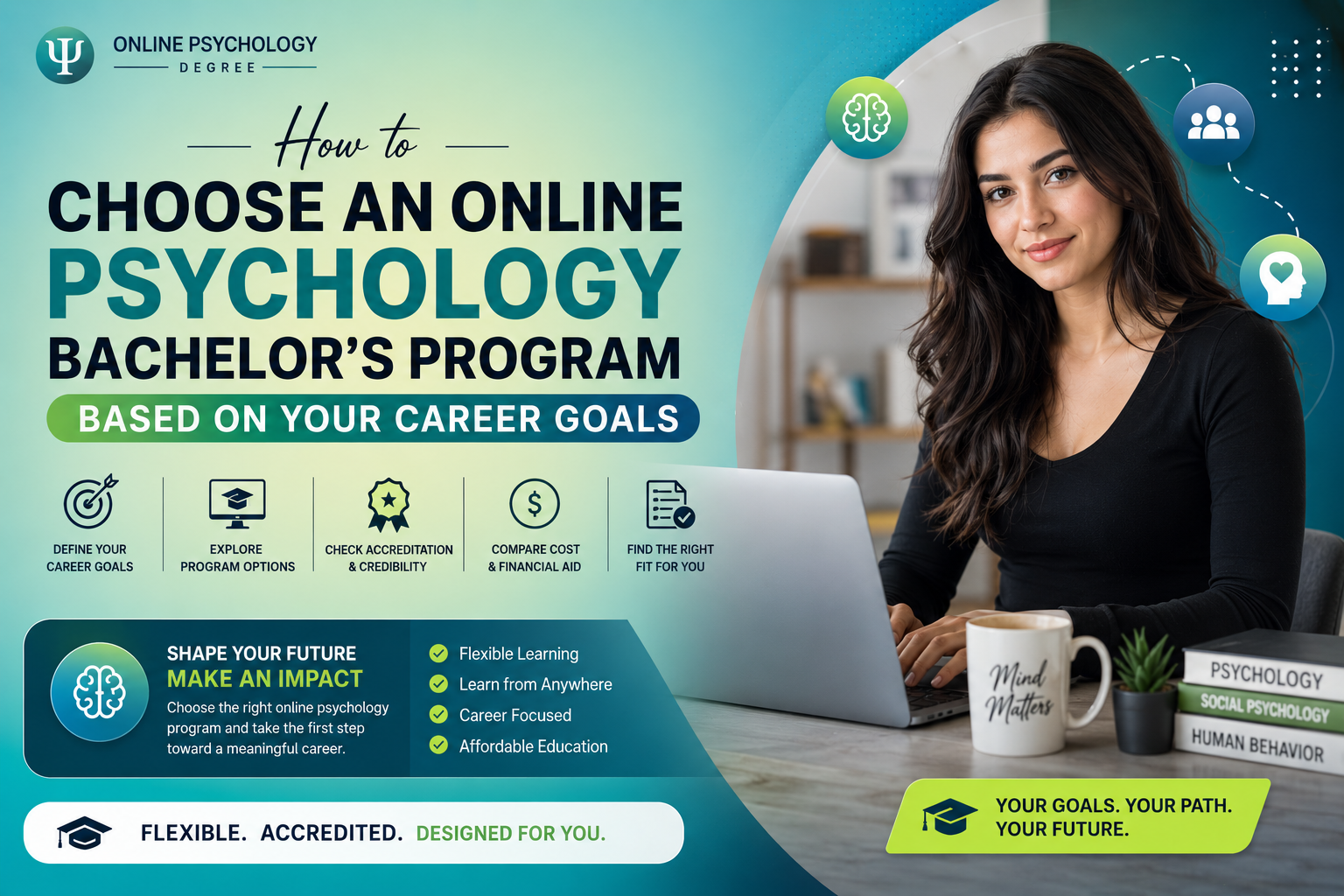
That’s the whole point of this article. Your career goal should decide the program, not the other way around.
Step 1: Get Brutally Honest About Your End Goal
Before you even open a browser tab to compare schools, sit down and answer this: what do you actually want your day-to-day work to look like in five or ten years?
I know that sounds obvious, but psychology is a weirdly broad field. “I want to help people” is not specific enough — it can lead you toward completely different paths:
- Licensed therapist or counselor (needs a master’s minimum, usually LPC, LMFT, or LCSW route)
- Clinical or counseling psychologist (needs a doctorate — PsyD or PhD)
- School psychologist (needs a specialist-level degree, EdS or similar)
- Human resources or organizational development (bachelor’s can be enough, especially paired with certifications)
- Case manager or social services worker (bachelor’s often sufficient depending on state)
- Research assistant or academic path (needs strong research background even at undergrad level)
- UX researcher or behavioral analyst in tech (bachelor’s plus stats/data skills can actually get you in the door)
Each of these wants a slightly different flavor of undergraduate education. A program heavy on research methods and statistics is gold if you’re eyeing grad school or research work. A program with practicum placements and applied coursework matters more if you’re aiming for social services or case management right after graduation.
Write your answer down. Seriously. You’ll refer back to it constantly while comparing programs.
Step 2: Check Accreditation — But Understand What It Actually Means
Everyone says “make sure it’s accredited,” but almost nobody explains accreditation properly, so let me try.
For undergraduate psychology, you want regional accreditation at minimum — this used to be split into agencies like the Higher Learning Commission (HLC) or Middle States Commission on Higher Education (MSCHE), and since 2020 the US Department of Education has streamlined the terminology, but the schools still list their accrediting body on their website footer.
Regional accreditation matters because:
- Your credits will actually transfer if you switch schools
- Grad schools will take your degree seriously
- Federal financial aid usually requires it
There’s a separate thing called APA accreditation, but here’s the catch — the American Psychological Association only accredits doctoral programs, internships, and postdoc programs. There’s no such thing as an “APA-accredited bachelor’s degree,” and if a website claims that, it’s a red flag. I actually caught a shady program my friend was looking at that had “APA-aligned curriculum” plastered everywhere — technically true-ish, meaningless in practice, and clearly written to make people assume something false.
Quick way to check accreditation: search the school name directly on the U.S. Department of Education’s database (ope.ed.gov/dapip) instead of trusting the claims on the program’s own marketing page.
Step 3: Look at the Curriculum Like You’re Buying a Car, Not a Brochure
This is the step most people skip because it’s boring. Don’t skip it.
Pull up the actual course catalog — not the marketing page, the real degree plan PDF, usually buried under “Academics” or “Program Requirements.” Look specifically for:
If you’re headed toward grad school or clinical work:
- Research Methods (usually two courses, not one)
- Statistics for Psychology (not generic stats — psych-specific is better)
- Abnormal Psychology
- Biological/Physiological Psychology
- A capstone project or thesis option
If you’re headed toward HR, business, or organizational roles:
- Industrial-Organizational Psychology
- Social Psychology
- Personality Psychology
- Some kind of business or management elective track
If you’re headed toward social services or case work:
- Developmental Psychology
- Community Psychology
- Practicum or internship placement options (huge — more on this below)
I made a spreadsheet for my friend comparing five programs side by side, row by row, with these exact categories. It looked tedious, but it took the guesswork out completely and made the differences between programs obvious in a way marketing copy never does.
Step 4: Internship and Practicum Access Is a Bigger Deal Than People Realize
Here’s something that genuinely surprised me. A lot of fully online psychology bachelor’s programs either don’t offer practicum placements at all, or they leave it entirely on you to find and set one up yourself.
That matters a lot more than it sounds like. If you want any kind of applied experience — working in a school, a clinic, a nonprofit, a research lab — before you graduate, you need a program that actually helps place you or has a formal internship coordinator.
One of my friends went with Arizona State University’s online psychology program partly because they have a dedicated career and practicum services team that helps online students find placements near where they actually live. That was a deciding factor for her over a cheaper program that basically said “students are responsible for arranging their own field experience” in the fine print.
Ask directly, before enrolling: “Does the online program have staff dedicated to helping students find internships or practicum placements in their local area?” If the answer is vague, that’s your answer.
Step 5: Think About How the Program Actually Delivers Classes
Online doesn’t mean the same thing at every school. There are real differences:
- Asynchronous — you watch lectures and do work on your own schedule, deadlines are usually weekly. Good for people working full-time or with unpredictable schedules.
- Synchronous — live Zoom-style classes at set times. Better if you want more direct interaction with professors, harder if you’re juggling a job with fixed hours.
- Hybrid — mix of both, sometimes with occasional in-person requirements (some schools require a handful of on-campus weekends even for “online” degrees).
I’ve talked to people who assumed “online” meant total flexibility and then got blindsided by mandatory live class times at 10am on a Tuesday that conflicted with their job. Always check the actual class format before enrolling, not just the marketing phrase “online degree.”
Most schools run their courses through Canvas, Blackboard, or Brightspace — worth asking which one, since if you’ve used one before, the learning curve is basically zero, and if you haven’t, budget a week or two to get comfortable navigating it.
Step 6: Compare Cost the Right Way (Not Just Sticker Price)
Don’t just look at “tuition per credit hour.” Look at total cost to degree completion, factoring in:
- Technology fees (some schools charge $200–500 per semester just for “online learning support”)
- Whether they accept transfer credits from community college (can save thousands)
- Whether they offer any prior learning assessment credit if you have relevant work experience
- In-state vs out-of-state online tuition — some public universities charge online students the in-state rate regardless of where you live, others don’t
Southern New Hampshire University (SNHU) and Purdue University Global tend to come up a lot in these comparisons because of relatively lower per-credit costs and no-application-fee policies, but “relatively lower” still means real money over four years, so actually build out the math yourself rather than trusting a ranking site’s summary.
Real Example: Two Different People, Two Different Right Answers
To make this less abstract, here’s how it played out for two people I actually helped through this.
Person A wanted to eventually become a licensed clinical psychologist. She picked a program with strong research methods coursework, a required senior thesis, and faculty who actively published research (checkable through the faculty bio pages — look for actual publication lists, not just “Dr. So-and-so has a PhD”). She ended up doing an independent study project that she later used in her grad school application essays. That research experience is genuinely what got her into a competitive PhD program later.
Person B wanted to work in HR after graduating, no plans for grad school. He picked a program with an Industrial-Organizational psychology track and business electives, skipped programs that were research-heavy, and prioritized one with a strong career services department that had relationships with local employers. He had a job lined up in talent acquisition before he even graduated, through a connection made at a career fair the school hosted specifically for online students.
Same degree title. Completely different program choice. Both right decisions — because they matched the goal.
Common Mistakes to Avoid
Picking based on brand name alone. A recognizable university name doesn’t automatically mean their online program is well-run. Some big-name schools outsource their online programs to third-party platform companies with wildly different quality than the on-campus version.
Ignoring transfer credit policies. If you already have some college credit, ask specifically what transfers before you commit, not after.
Assuming all online programs have the same support services. Tutoring, career counseling, mental health services, disability accommodations — these vary a lot. Ask if online students get full access to the same student services as on-campus students, or a scaled-down version.
Not checking state licensing implications early. If you plan to eventually get licensed as a counselor or therapist, some states have specific education requirements. It sounds early to think about this at the bachelor’s stage, but grad programs often expect specific undergrad coursework, so it’s worth a quick look now.
Underestimating the self-discipline factor. Online programs give you freedom, but nobody’s chasing you to turn in work. If you know you struggle with self-directed schedules, look specifically at programs with more structure (weekly live sessions, firm deadlines) rather than fully self-paced ones.
A Simple Way to Actually Decide
If you’re stuck between a few options, try this: make a table with your top 3–4 programs as columns, and these rows —
- Accreditation status (confirmed via ope.ed.gov)
- Core courses relevant to your specific goal
- Internship/practicum support
- Class format (sync/async/hybrid)
- Total cost to completion
- Career services quality
- Faculty research or industry connections relevant to your path
Fill it out with actual facts, not gut feelings. The answer usually becomes obvious once it’s in front of you in black and white instead of living in ten open browser tabs.
Final Thoughts
Picking an online psychology bachelor’s program isn’t really about finding the “best” school in some general ranking sense. It’s about finding the program whose specific strengths line up with the specific thing you want to do next. A program that’s perfect for someone headed toward a PhD might be a mediocre choice for someone headed straight into HR, and vice versa.
Take the extra few hours to actually dig into course catalogs and ask direct questions to admissions counselors. It’s genuinely worth more than any ranking list, including this article’s advice about what to look for. The goal isn’t to find a shortcut — it’s to stop guessing.
FAQs
1. Can I become a therapist with just a psychology bachelor’s degree? Generally no. Licensed therapist roles (like LPC, LMFT, or LCSW) require a master’s degree at minimum, plus supervised clinical hours and passing a licensing exam. A bachelor’s degree is the foundation, not the finish line, for clinical roles.
2. Is an online psychology degree taken as seriously as an in-person one by employers or grad schools? Mostly yes, as long as the school is regionally accredited and the degree itself doesn’t say “online” on the diploma (most don’t — it just says the degree, not the delivery method). What matters more to employers and grad schools is your coursework, GPA, and any research or field experience, not whether your classes were on Zoom or in a lecture hall.
3. How long does an online psychology bachelor’s degree typically take? Usually four years full-time, same as on-campus, though many online programs let you go faster with year-round terms or slower if you’re working full-time. Some accelerated online formats compress it to around three years if you take a heavier course load.
4. What’s the difference between a BA and a BS in psychology? A BA (Bachelor of Arts) usually has more flexibility with electives and sometimes a foreign language requirement, while a BS (Bachelor of Science) typically has heavier science and statistics requirements. If you’re leaning toward research or clinical grad programs, a BS often lines up better, though it varies by school, so check the actual course list rather than assuming based on the letters alone.
5. Do online psychology programs require any in-person time at all? It depends entirely on the school. Some are 100% online with zero in-person requirements. Others require occasional on-campus intensives, in-person practicum hours (which happen locally, not at the main campus), or proctored exams. Always confirm this specific detail before enrolling, especially if you can’t travel easily.