Three years ago I was sitting in a parking lot outside a community college, engine running, staring at a course catalog on my phone and doing that thing where you calculate gas money against tuition money and neither number makes you feel better. I had a full-time job, a kid who needed picking up from daycare by 5:30, and a genuine itch to finish the psychology degree I’d started and abandoned back in 2016. Driving to campus twice a week just wasn’t going to happen.
So I did what a lot of people do now — I went looking for a fully online psychology bachelor’s program. And honestly, the amount of conflicting information out there almost talked me out of it. Some articles made it sound like online degrees are basically a scam. Others made it sound like you just click a few buttons and a diploma shows up in the mail. Neither is true, and I learned that the hard way over about two and a half years of actually doing it.
If you’re where I was — juggling life, wondering if this is even realistic — I want to walk you through what the process actually looks like, what I got wrong, and what I’d do differently if I started today.
Short answer: yes, it’s real, and it’s fairly common now
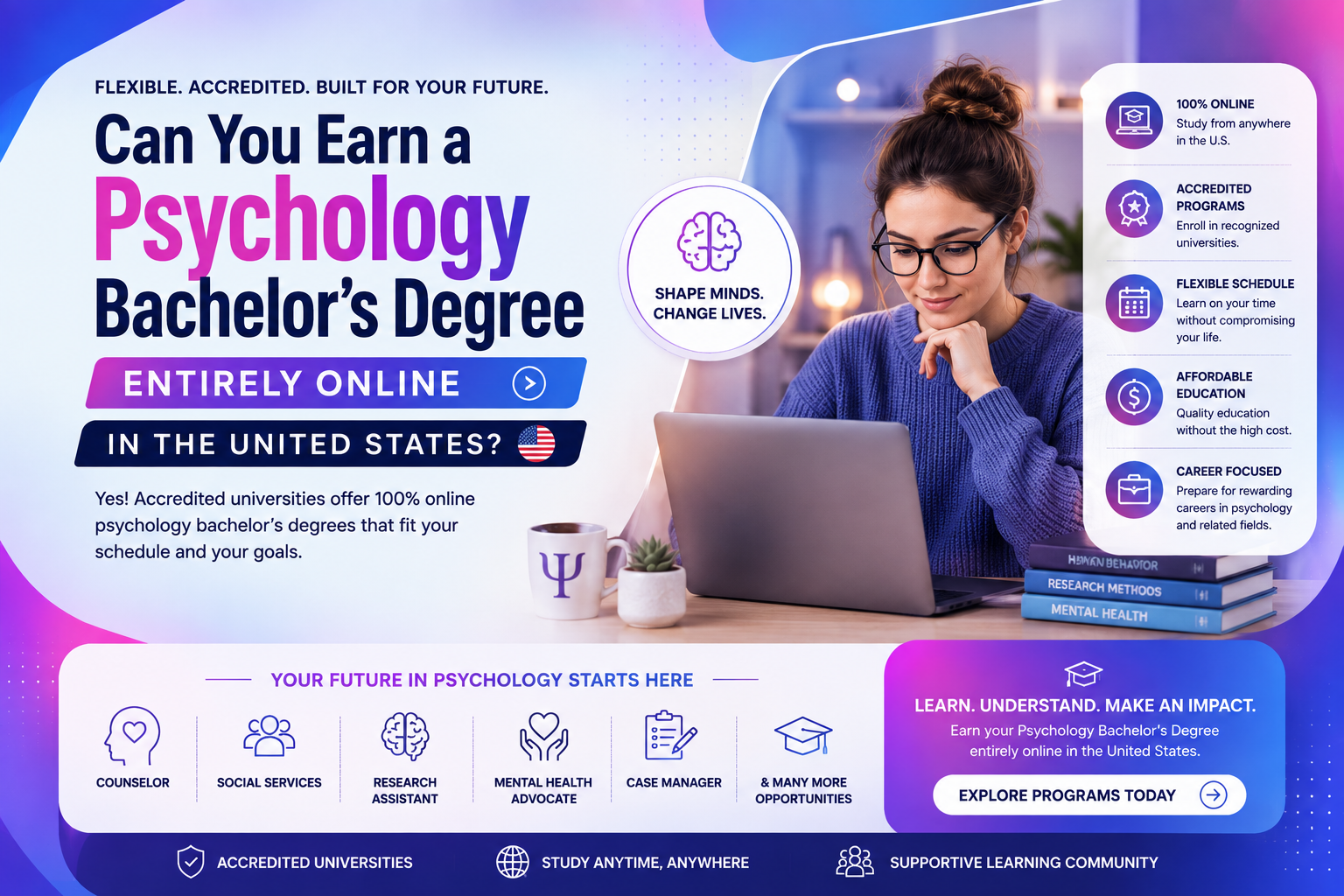
You absolutely can complete a full Bachelor of Arts or Bachelor of Science in Psychology online in the US, from a properly accredited university, without ever setting foot on a campus. This isn’t some sketchy workaround. Schools like Arizona State University, Southern New Hampshire University (SNHU), Penn State World Campus, University of Florida Online, and Purdue Global all run legitimate, regionally accredited online psych programs. I ended up going with a state university’s online division, partly because it was cheaper as an in-state resident and partly because the credits transferred cleanly from my earlier college attempt.
The degree you get says “Bachelor of Arts in Psychology” — it doesn’t say “online” anywhere on it. Employers and grad schools generally don’t ask how you attended class, they ask where the degree is from and whether the school was accredited.
That said, “you can do it” and “it’s easy” are two very different sentences. Let me get into the real stuff.
What accreditation actually means (and why I almost skipped checking it)
When I first started looking, I nearly enrolled in a program that looked polished, had a slick website, and was noticeably cheaper than everywhere else. I got maybe two weeks into researching before a financial aid advisor at a different school flagged something for me: the cheap program wasn’t regionally accredited, it had something called “national accreditation” through a body I’d never heard of.
Here’s the difference in plain English:
- Regional accreditation is the gold standard in the US. It’s what most public and respected private universities have. Credits transfer between regionally accredited schools reasonably well, and grad schools take these degrees seriously.
- National accreditation is often used by trade schools and career-focused institutions. It’s not automatically bad, but credits from these schools frequently don’t transfer to regionally accredited universities, and some grad programs won’t accept them.
Before you enroll anywhere, go to the school’s website and search for their accreditor, then cross-check that accreditor on the US Department of Education’s database (ope.ed.gov/dapip) or the Council for Higher Education Accreditation (CHEA) website. It takes ten minutes and it can save you years of wasted credits.
Picking a program: what actually mattered once I was in it
I looked at probably fifteen different programs before choosing one. Looking back, here’s what actually ended up mattering versus what I stressed over for nothing.
Things that mattered a lot:
- Cost per credit hour, not just the sticker price. Psych degrees are usually 120 credits. A $50 difference per credit adds up to $6,000 over a degree.
- Whether classes were synchronous or asynchronous. Synchronous means live class sessions at set times over Zoom. Asynchronous means you log in whenever and complete work by deadlines. I needed asynchronous because of my work schedule, and this was honestly the single biggest factor in whether I could actually finish.
- Transfer credit policy. I had about 45 credits from my earlier attempt at a different school. Some programs only accepted 30 max. I lost almost a semester’s worth of progress because I didn’t check this before applying.
Things I stressed about that didn’t end up mattering:
- Whether the professors were “real” professors or adjuncts. Honestly some of my best instructors were adjuncts who worked actual jobs in mental health and brought real experience into the discussion boards.
- Prestige of the school name. Nobody in my current job has ever asked which specific university I graduated from.
What the day-to-day actually looks like
People imagine online school as watching pre-recorded lectures in your pajamas, and sometimes that’s exactly it, but there’s more structure than most people expect.
A typical week in one of my classes looked like this:
- Monday — new module opens, I’d read the assigned textbook chapter and watch a recorded lecture, usually 20 to 40 minutes.
- Wednesday — initial discussion board post due, answering a prompt about the material, usually 250 to 400 words.
- Saturday — reply to two classmates’ posts, plus any quiz for the week.
- Ongoing — bigger assignments like papers or case study analyses due roughly every two to three weeks depending on the course.
I used a mix of tools to keep this from falling apart. Google Calendar with color-coded blocks for each class saved me more than once. I also leaned on Grammarly for a first-pass edit on papers before submitting, and Zotero to keep my APA citations from turning into a nightmare during research-heavy courses. Most schools also give you access to a learning management system — mine used Canvas, though Blackboard and Brightspace are common too — and getting comfortable navigating that system in the first week saves a lot of headaches later.
The mistakes I made (so you don’t have to)
I want to be honest about where I messed up, because the “everything went smoothly” version of this story wouldn’t help anybody.
Mistake one: I underestimated the reading load. Psychology courses, especially research methods and statistics, have real reading requirements. I treated the first module like it was optional pacing and fell two weeks behind by week five. Lesson learned — treat the syllabus schedule like it’s a boss you report to, not a suggestion.
Mistake two: I isolated myself completely. I assumed online meant solo, so I never reached out to classmates or professors. Then I hit Research Methods in Psychology, which absolutely wrecked me the first attempt, and realized other students in the discussion boards had formed informal study groups on GroupMe that I’d been missing out on the entire time. Once I joined one for my next stats class, it made a genuine difference.
Mistake three: I didn’t use office hours. Online professors almost always hold virtual office hours over Zoom, and almost nobody shows up to them. I started going halfway through my second year and it changed how I understood the material, plus it helped when I needed letters of recommendation later for grad school applications.
Mistake four: I didn’t plan for proctored exams. Some courses required proctored testing through software like Proctorio or Respondus LockDown Browser, which uses your webcam to monitor you during exams. The first time I hit one of these, I hadn’t tested my webcam or cleared my desk, and I lost fifteen minutes of exam time troubleshooting. Test your setup the day before, not the hour before.
Internships and practicum hours — the part people forget to ask about
This is the piece that trips people up the most, and I almost got tripped up by it too. Psychology degrees, especially if you eventually want to go into clinical or counseling work, often expect some kind of practical or applied experience component.
Fully online programs handle this differently. Some require an internship that you arrange locally, meaning you find a placement — a mental health clinic, a school counseling office, a nonprofit — in your own area, and the university just approves and supervises it remotely through periodic check-ins. Others offer a fully academic capstone project instead, no in-person requirement at all.
I’d strongly recommend asking this question directly to an admissions counselor before enrolling: “Does this program require any in-person practicum, internship, or lab component, and if so, how is it arranged?” Get the answer in writing if you can, because course catalogs aren’t always upfront about it.
What this degree actually qualifies you for
I want to be straightforward here because there’s a lot of fuzzy marketing around psychology degrees generally, online or not.
A bachelor’s in psychology by itself does not make you a licensed therapist, counselor, or psychologist. Licensure in those fields requires a master’s or doctoral degree plus supervised clinical hours plus a state licensing exam, regardless of whether your bachelor’s was online or in person.
What a psychology bachelor’s does open up:
- Entry-level roles in human resources, case management, social services, market research, and applied behavior analysis (some ABA roles specifically want a psych background)
- A strong foundation if you plan to go on to a master’s in counseling, social work, or a PhD/PsyD program
- Research assistant or lab coordinator positions, particularly if you took research methods and stats seriously
- Case worker or program coordinator roles at nonprofits and community mental health agencies
I currently work as a case coordinator at a community health organization, and my online degree got me in the door the same as any traditional degree would have.
Step-by-step: how I’d approach this if I were starting today
If you’re seriously considering this route, here’s the order I’d actually do things in.
- Check your state’s residency requirements for financial aid and tuition rates first, since online doesn’t always mean in-state pricing, and this changes the math a lot.
- Shortlist 3 to 5 regionally accredited schools with online psych programs — ASU Online, Penn State World Campus, SNHU, University of Florida Online, and your own state university’s online division are all solid starting points to research.
- Verify accreditation independently using ope.ed.gov/dapip rather than trusting the school’s own claims.
- Call admissions and ask about transfer credits, practicum requirements, and whether classes are synchronous or asynchronous.
- Request a sample syllabus for a couple of core courses if they’ll give you one, so you know what the workload actually looks like.
- Set up your study system before day one — calendar, a quiet workspace, and whatever citation and writing tools you’re comfortable with.
- Talk to current or former students if the school can connect you with any, since their experience of the workload will be more honest than the brochure.
Common mistakes to avoid overall
- Choosing the cheapest program without checking accreditation
- Assuming “online” automatically means “self-paced” — most programs still have hard weekly deadlines
- Skipping the FAFSA because you assume online students don’t qualify for aid — they do, in the same way traditional students do
- Not asking about practicum or internship requirements before enrolling
- Going it alone instead of using discussion boards, study groups, and office hours
Final thoughts
Finishing this degree online didn’t feel like a lesser version of college, it felt like college that fit around my actual life instead of the other way around. It took discipline I didn’t always have on the first try, and there were stretches where I fell behind and had to claw my way back. But the degree on the wall behind my desk right now is the same as anyone else’s, and nobody’s ever once asked me how I earned it.
If you’re weighing this option because life just doesn’t leave room for a traditional campus schedule, know that the online route is a legitimate, well-worn path at this point — not a shortcut, not a scam, just a different format for the same work.
FAQs
Is an online psychology bachelor’s degree respected by employers? Generally yes, as long as it’s from a regionally accredited university. The diploma doesn’t indicate the delivery method, and most employers care more about the accreditation and your actual skills and experience than whether classes were in person.
How long does it take to finish an online psychology bachelor’s degree? Most full-time students finish in about 4 years, same as on campus. Many online programs offer accelerated terms (like 8-week sessions instead of 16-week semesters), which can shorten that to around 3 years if you take courses back-to-back. Part-time students, like I was for a stretch, often take 5 to 6 years.
Can I become a therapist with just an online psychology bachelor’s degree? No. A bachelor’s degree, online or in person, isn’t sufficient for licensure as a therapist, counselor, or psychologist in any US state. You’ll need a master’s or doctoral degree plus supervised clinical hours and a licensing exam afterward. The bachelor’s is the foundation, not the finish line.
Do online psychology programs require any in-person work? It depends entirely on the program. Some require a locally arranged internship or practicum with remote supervision from the university; others offer a fully academic capstone with no in-person component. Always confirm this directly with admissions before enrolling.
Is financial aid available for online psychology degrees? Yes. As long as the school is accredited and eligible for federal student aid, you can apply through the FAFSA just like a traditional student, and many online programs also offer their own scholarships specifically for online learners.