
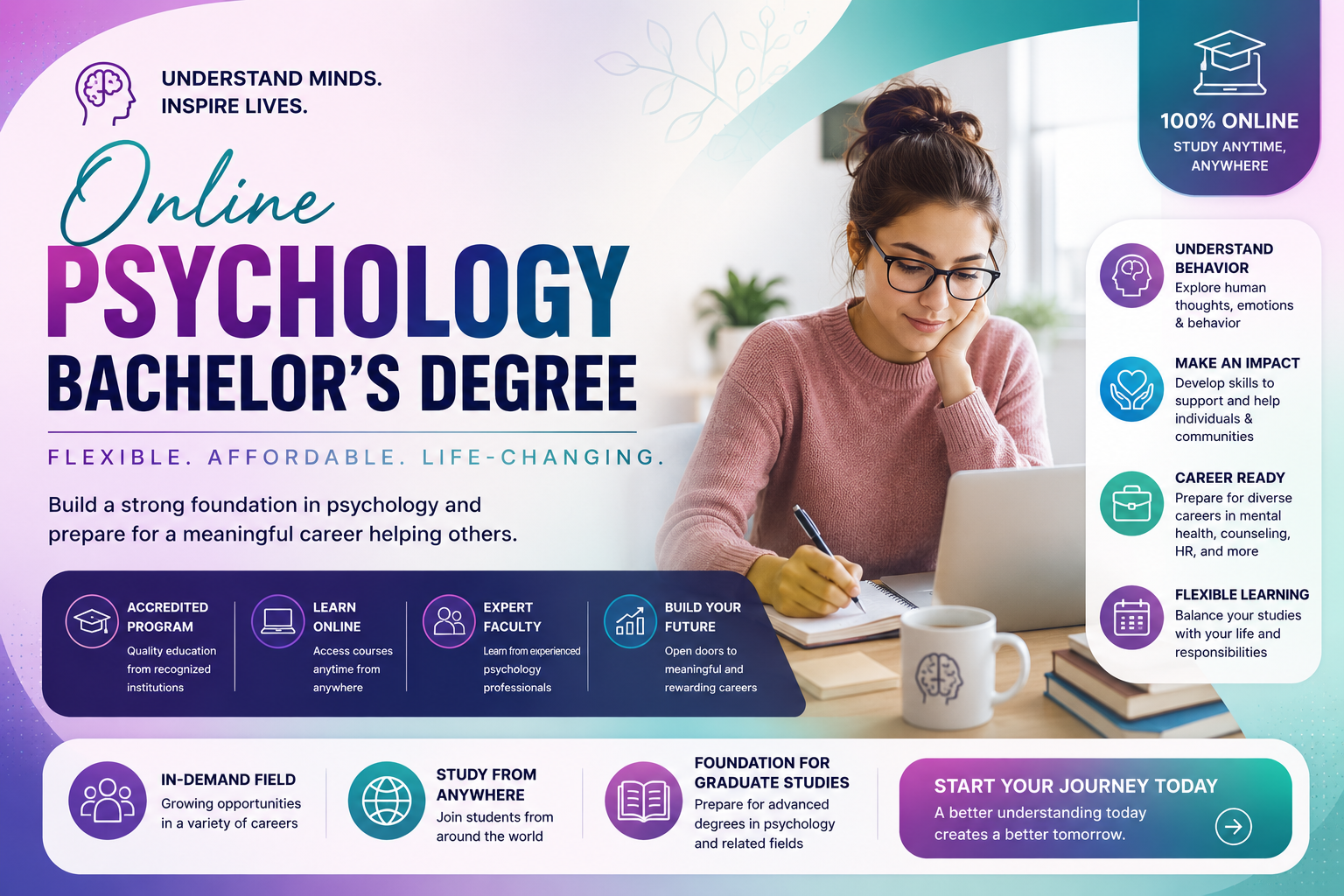
My neighbor’s daughter, Juli, texted me at almost midnight last spring asking if she should sign up for an online psychology program that was running a “50% off if you enroll this week” deal. She’d already filled out half the application. I told her to close the laptop and call me in the morning instead.
That conversation turned into a two-hour coffee chat, and honestly, it’s the same conversation I’ve now had with about six different people over the past couple of years. Online psychology degrees have become one of those things everyone seems to be considering — maybe you want to become a therapist eventually, maybe you’re just curious about human behavior, or maybe you’re switching careers after realizing your current job makes you miserable. Whatever the reason, the online route sounds convenient. And it can be. But there’s a lot nobody tells you upfront, and some of it only becomes obvious after you’ve already paid the enrollment fee.
I’ve spent time researching these programs closely, talked to students currently enrolled in a few of them, and watched friends go through the entire process from application to graduation. This isn’t a sales pitch for any particular school. It’s the stuff I wish someone had laid out plainly before Priya almost clicked “submit” on a program that, frankly, wasn’t right for her goals.
Why Psychology Is Such a Popular Online Major Right Now
Psychology consistently ranks as one of the most-enrolled majors in the country, and a big chunk of that growth is happening online. Part of it is flexibility — a lot of people going for this degree are working adults, parents, or career-changers who can’t just pause their life to sit in a lecture hall three days a week.
The other part is that psychology feels accessible. You don’t need to have taken four years of AP Chemistry to feel like you belong in an intro psych class. The subject matter — why people do what they do, how memory works, what causes anxiety — is relatable from day one.
But accessible doesn’t mean easy, and popular doesn’t mean every program is equally good. That distinction matters a lot once you start comparing options.
The First Mistake People Make: Confusing “Online” With “Easy”
I want to get this out of the way early because it trips up so many people. An online psychology bachelor’s degree is not a shortcut. The coursework is generally the same rigor as an in-person program — research methods, statistics, developmental psychology, abnormal psychology, cognitive psychology. You’re still writing research papers, still doing statistical analysis (yes, psychology majors take stats, and yes, it surprises people every single time), and still expected to read dense academic material.
What changes is the delivery method, not the difficulty. A friend of mine, Daniel, told me he assumed his online courses would be “watch a video, take a quiz, done.” His first semester statistics class corrected that assumption fast. He ended up spending more hours per week on that one class than any other class he’d taken in years.
So if convenience is the only reason you’re drawn to online programs, that’s fine — just don’t expect the workload to be lighter.
Accreditation: The One Thing You Cannot Skip Checking
This is the single most important thing on this entire list, so I’m putting it near the top instead of burying it in the middle.
Before you even look at tuition or course schedules, check whether the school holds regional accreditation. In the U.S., regional accreditation (now sometimes called institutional accreditation under the newer system) is what most employers, licensing boards, and other universities recognize. If you ever want to transfer credits, apply to a master’s program, or eventually pursue licensure as a counselor or psychologist, an unaccredited or “nationally accredited only” degree can become a serious roadblock.
Here’s how to actually check it, step by step:
- Go to the school’s official website and look for an “accreditation” page, usually in the footer or under “About.”
- Cross-reference that claim on the U.S. Department of Education’s database (search “Database of Accredited Postsecondary Institutions and Programs”) or the Council for Higher Education Accreditation (CHEA) website.
- Confirm it’s regional accreditation specifically, not just accreditation from some obscure agency you’ve never heard of.
- If the psychology program itself has additional accreditation (some undergrad programs are recognized separately, though this matters more at the graduate level), note that too.
I’ve seen ads for schools that sound legitimate, with professional-looking websites and testimonials, that turn out to hold only questionable accreditation. Students don’t find out until they try to transfer credits or apply for a job that requires a “regionally accredited degree” and get quietly rejected.
What the Coursework Actually Looks Like
A typical online psychology bachelor’s degree runs about 120 credit hours, same as the in-person version, spread across four years if you’re full-time (longer if you’re part-time, which a lot of working students are).
You’ll generally see a mix like this:
- General education requirements — English composition, math, a lab science, humanities
- Psychology core courses — Introduction to Psychology, Research Methods, Statistics for Behavioral Sciences, Developmental Psychology, Abnormal Psychology, Biological Psychology, Social Psychology, Cognitive Psychology
- Electives or a concentration — some schools let you specialize in areas like child psychology, forensic psychology, or industrial-organizational psychology
- A capstone project or research paper in your final year
Most programs use a learning management system like Canvas, Blackboard, or Moodle. Classes are typically either asynchronous (you watch pre-recorded lectures and complete work on your own schedule within a weekly deadline) or synchronous (live Zoom sessions at set times). Some programs mix both. If you have a job with unpredictable hours, ask specifically about this before enrolling — it matters more than people expect.
Real Talk: The Discussion Board Grind
Nobody warns you about discussion boards enough, so I will. A huge chunk of your grade in most online psych courses comes from posting responses to classmates and replying to their posts. It sounds simple, but doing it well — actually engaging with the material instead of writing “I agree, great point!” fifty times a semester — takes real effort and time management.
Set a routine early. I’ve watched people fall behind simply because they treated discussion posts as an afterthought, then scrambled to catch up before the weekly deadline hit. A simple fix: pick two set days a week (say, Tuesday and Friday) where you log in specifically for discussion posts, separate from when you’re doing readings or assignments.
Tools That Actually Help
A few things that came up repeatedly when I talked to current students about what made their workload manageable:
- Grammarly — for catching the small writing errors that add up across dozens of papers
- Zotero or Mendeley — free citation managers that save enormous time formatting APA references (and psychology is APA style through and through, so get comfortable with it early)
- Google Calendar or Notion — for tracking assignment deadlines across multiple asynchronous courses, since nothing reminds you the way an in-person class schedule does
- Quizlet — genuinely useful for memorizing psychological disorders, theorists, and terminology before exams
- Khan Academy or Crash Course Psychology on YouTube — good supplemental explainers when a textbook chapter isn’t clicking
None of these are required by your school, but students who use them consistently tend to describe the workload as manageable instead of overwhelming.
Cost: What People Underestimate
Online doesn’t automatically mean cheap. Public universities offering online psychology degrees often charge in-state tuition rates regardless of where you physically live, which can be a genuine bargain. Private online-only universities can cost significantly more per credit hour, sometimes rivaling or exceeding traditional four-year tuition once you add fees.
Before enrolling anywhere, do this:
- Ask for the full cost per credit hour, not just an advertised “starting at” number.
- Ask about technology fees, which some schools tack on separately and don’t always advertise upfront.
- Fill out the FAFSA regardless of whether you think you’ll qualify for aid — a lot of students skip it assuming they won’t get anything and miss out on federal loans or grants they were actually eligible for.
- Look into whether the school offers a payment plan versus requiring lump-sum payment per term.
Daniel, the friend I mentioned earlier, ended up transferring from a private online university to a public state school’s online program halfway through his second year because the cost difference was almost half. He lost a small number of credits in the transfer, which stung, but it saved him thousands over the remaining two years.
What You Can Actually Do With This Degree
This is where I have to be honest with you, because a lot of marketing around psychology degrees glosses over it. A bachelor’s degree in psychology alone does not make you a licensed therapist, counselor, or psychologist. Those careers require a master’s degree at minimum, often a doctorate, plus supervised clinical hours and passing a licensing exam.
What a bachelor’s degree does open up:
- Entry-level roles in human resources, case management, social services, or community outreach
- Research assistant positions, especially if you did undergraduate research
- Roles in ABA (Applied Behavior Analysis) therapy as a behavior technician, often requiring additional certification
- A strong foundation if you plan to go to graduate school for clinical psychology, counseling, school psychology, or a related field
- Careers outside clinical psychology entirely — marketing, UX research, and human resources all value the understanding of human behavior a psych degree provides
If your end goal is to sit across from clients as a licensed therapist, plan for the full journey, not just the bachelor’s step. Ask any program you’re considering directly: “What percentage of your graduates go on to graduate programs, and which ones?” A reputable school should be able to answer that without dodging.
Talking to a Real Advisor Before You Enroll
Every legitimate university has academic advisors, and most offer a free consultation call before you commit to anything. Use it. Come with specific questions:
- What’s the average class size for online sections?
- Is there a required internship or practicum, and how is that arranged for online students?
- What support exists for online students — tutoring, writing centers, career services — and is it actually accessible remotely?
- How many students graduate within four to six years?
- What’s the total cost including fees, not just tuition?
I sat in on one of these calls with Priya eventually. The advisor was straightforward about internship requirements needing to be arranged locally, which Priya hadn’t considered at all. That single question saved her from a headache down the road.
Common Mistakes Students Make (Learned the Hard Way)
Enrolling based on ads or urgency tactics. Programs that push “enroll before this deadline for a discount” are using sales tactics, not academic ones. A real degree decision shouldn’t be rushed by artificial urgency.
Not checking transfer credit policies early. If you already have some college credits, ask specifically how many will transfer before you enroll, not after.
Underestimating internship or practicum requirements. Some online psychology programs still require in-person internship hours, arranged near wherever you live. If you’re planning to move during your degree, this can complicate things.
Ignoring the school’s graduation rate. A low graduation rate for online programs specifically (not just the university overall) can be a red flag about how supported students actually feel once they’re enrolled.
Assuming financial aid works the same everywhere. Federal aid rules differ for online-only programs versus hybrid ones. Confirm this directly with financial aid, not just admissions.
Skipping the syllabus review before the semester starts. Once you can access your course shell, read the syllabus fully in week one. Weekly deadlines, participation expectations, and grading breakdowns vary a lot between professors even within the same program.
A Realistic Week in the Life
To give you a sense of what this actually feels like day to day: a typical week for a full-time online psych student might include watching three to five hours of recorded lectures, reading one or two textbook chapters, writing two discussion board posts with replies to classmates, and working on a paper or problem set due at the end of the week. Add in an exam roughly every three to four weeks per course.
For someone juggling a job, that’s usually somewhere between 15 and 25 hours a week per full course load, depending on how quickly you read and write. It’s manageable, but it’s not passive. Treat it like a part-time job with deadlines, because that’s essentially what it becomes.
Final Thoughts
Priya ended up enrolling in a different program than the one she’d almost rushed into — a public university with clear regional accreditation, a lower per-credit cost, and an advisor who answered every question honestly on that first call. She’s in her third year now, working part-time, and says the discussion boards still aren’t her favorite thing, but she’s genuinely learning and knows exactly what graduate program she wants to apply to next.
That’s really the goal here. Not to scare you away from an online psychology degree, because for a lot of people it’s a genuinely good option that fits real life better than sitting in a lecture hall ever could. Just don’t let convenience talk you out of doing the homework on the school itself first. Check the accreditation. Ask the hard questions. Look at real costs, not advertised ones. The degree can absolutely be worth it — just make sure it’s the right one before you sign anything.
FAQs
Is an online psychology bachelor’s degree respected the same as an in-person one? Yes, as long as the school holds proper regional accreditation. Most employers and graduate programs don’t distinguish between online and in-person delivery on a diploma — they care about the accreditation and the institution’s reputation, not the format the classes were delivered in.
Can I become a therapist with just a bachelor’s degree in psychology? No, not on its own. Licensed therapists, counselors, and psychologists all require graduate-level education (a master’s degree at minimum, often a doctorate) plus supervised clinical hours and a licensing exam. A bachelor’s degree is the foundation, not the finish line, for clinical careers.
How long does an online psychology bachelor’s degree usually take? Full-time students typically finish in about four years, similar to in-person programs. Part-time students, which make up a large share of online enrollees, often take five to six years depending on how many courses they take per term.
Do online psychology programs require any in-person components? Sometimes, yes. Some programs require an internship, practicum, or occasional proctored exam that needs to happen in person or at an approved testing location near you. Always ask about this specifically before enrolling, especially if you’re not near a major city.
How much does an online psychology bachelor’s degree typically cost? It varies widely. Public universities offering online programs often charge similar rates to their in-state in-person tuition, which can be a few hundred dollars per credit hour. Private online universities can charge more. Always ask for the full cost breakdown, including fees, rather than relying on advertised starting prices.